What Team Syzygy does

Team Syzygy helps managers surface quiet or half-verbalised team tensions before they become fixed patterns. It compares what people personally prefer, what they believe the team norm currently is, and how clearly that norm has been discussed or agreed.

Each Team Syzygy dimension captures three signals:

Help us validate Team Syzygy

You are reviewing a prototype Team Syzygy diagnostic for a mock team. We are seeking honest feedback on whether this would be useful in a real team conversation — not whether every word is perfect.

Manager Report

Manager preparation

Read before the meeting.

One-minute summary

For the manager

Orient yourself on the main pattern before you open the conversation.

The strongest pattern is around Balanced Workload vs Uneven Distribution: the current team norm appears to lean toward uneven workload distribution, while preferences lean more toward balanced workload, and responses are split enough that the average may hide different definitions of fairness. The supporting pattern points in the same direction: Continuous Improvement vs Delivery Focus, Recognition vs Output-Only Culture, and Controlled Work Environment vs External Demands all show gaps with low clarity, suggesting that workload fairness may be difficult to resolve unless the team first makes explicit whether uneven work is driven by delivery pressure, external demands, or deliberate choices about capacity, skill, and business need.

What to do next

For the manager

Your facilitation guide: how to open, what to learn first, and what to clarify or decide.

Use the conversation to understand how people see workload fairness, share your own view of the trade-offs, and agree practical next steps the team can test.

Open with this

The pattern suggests that workload fairness is not just a question of whether work is uneven; the team appears to perceive some unevenness, but views may differ on what a fair workload should look like, with only moderate clarity around the primary issue and lower clarity around related delivery, recognition, and external-demand pressures.

Ask before you decide

  • When we say workload should be fair, what do people think fair should mean in practice?
  • Where does uneven workload feel acceptable because it is deliberate, and where does it feel unclear or accidental?
  • What do we currently recognise when someone carries more work, and what might be going unnoticed?
  • Which external demands or delivery pressures most affect how work gets distributed? frequently?

Then work through

Start with: Start with workload fairness as the main topic, rather than jumping straight to workload rebalancing.

Clarify: Clarify whether fair means equal load, capacity-based allocation, skill-based allocation, or business-need allocation.

Decide: Decide which version of fairness the team is actually choosing, especially when work cannot be distributed equally.

Recognise or monitor: Agree what should be recognised when work is uneven by design, and monitor whether the agreed version of fairness is still understood as circumstances change.

Aim for these agreements

  • Agree a working definition of fair workload for the team: equal, capacity-based, skill-based, business-need based, or a stated mix.
  • Agree how the team will tell the difference between deliberate unevenness and accidental drift.
  • Agree what should be recognised when someone takes on more work because of delivery focus or external demands.
  • Agree when the team will revisit workload distribution if the pattern starts to feel unclear again.

Avoid

  • Truth battles: Arguing about who is right keeps people defending their story. Explore perceptions and values instead.
  • Assuming intentions: You cannot know why someone acted as they did. Describe impact; ask about their view rather than asserting motive.
  • Blame frame: Focusing on fault blocks learning what keeps the pattern going and what to change in how the team operates.
  • Hit-and-run: Raising a serious topic in passing or by hint usually makes things worse. Plan a proper conversation or wait until you can.
  • Easing in: Indirect hints, jokes, or leading questions often confuse people. Be clear about what you want to discuss.
  • Survey as weapon: Using Team Syzygy data to prove others wrong triggers defensiveness. Use it to open exploration of shared and different stories.
  • Always and never: Absolute language invites argument about frequency. Describe patterns and examples instead.
  • Performance ranking: This report shows team-level operating patterns, not who is a strong or weak performer. Do not use it for individual rating.

Team conversation

Use in the room with the whole team.

Primary focus area

For the team meeting

Explore the main tension together: what is happening, what drives it, and questions to discuss.

Q9 Balanced Workload vs Uneven Distribution · Drift

Workload fairness needs a shared definition

What is happening: This is the central theme signal. The current norm appears to lean toward uneven workload distribution, while personal preferences lean toward balanced workload. Because consensus is split, the average may mask different experiences or different preferred versions of fairness.

What drives this:

  • Gap level is high (mean absolute gap 3.00).
  • Explicitness level is moderate (mean 3.86).
  • Quadrant state is Drift.
  • Consensus status is split consensus.
  • Perceived team norm leans toward uneven workload distribution; personal preference leans toward balanced workload distribution.

Why it matters: If the team does not share what fair means, the same workload pattern could be seen by some as reasonable allocation and by others as unmanaged unevenness. That makes it harder to discuss workload without people talking past each other.

Listen for: Listen for different definitions of fairness, especially whether people are describing equal effort, equal hours, capacity, skills, business need, or recognition for extra load.

Explore contribution: Explore how the team’s current planning, allocation, and escalation habits may contribute to unevenness without assuming that anyone is deliberately creating it.

What to discuss: Use this area to define fairness before deciding whether anything needs rebalancing: equal load, capacity-based allocation, skill-based allocation, business-need allocation, or a deliberate mix.

Questions to explore this pattern

  • What would make an uneven workload feel fair, and what would make it feel unfair, in this team?
  • What definition of fair workload would help us make clearer allocation decisions when equal distribution is not possible?
  • When delivery pressure increases, what should happen to improvement work rather than letting it disappear by default?
  • If work is uneven by design, what should be made visible and recognised so the unevenness does not feel accidental?
What looks steady

For the team meeting

Acknowledge what appears to be working and discuss it with the same care as the tensions.

Q6 Delivery Speed vs Work Quality · Implicit Alignment

Delivery speed and work quality look more aligned, but mostly implicitly

What is happening: Compared with the workload fairness theme, Delivery Speed vs Work Quality appears steadier because the alignment gap is low and both the current norm and preference lean toward delivery speed. However, explicitness is low and consensus is split, so the apparent alignment should not be overread as a fully shared agreement.

What drives this:

  • Gap level is low (mean absolute gap 0.86).
  • Explicitness level is low (mean 3.29).
  • Quadrant state is Implicit Alignment.
  • Consensus status is split consensus.
  • Perceived team norm leans toward delivery speed emphasis; personal preference leans toward delivery speed emphasis.

Why it matters: This steadier area could be useful because the team may already have an implicit leaning toward delivery speed, but split consensus means some people may hold different expectations about when speed should give way to quality.

Listen for: Listen for whether people share the same boundary between acceptable speed and unacceptable quality risk.

Explore contribution: Explore what keeps this area relatively aligned, such as shared delivery habits or expectations, without assuming everyone experiences the trade-off in the same way.

What to discuss: Acknowledge that delivery speed may be a relatively shared operating tendency, then make explicit where the team draws the line between moving quickly and protecting work quality.

Discussion prompt: When we prioritise delivery speed, what quality standards are non-negotiable?

Other focus areas

For the team meeting

Secondary patterns worth a shorter team discussion if time allows.

Q7 Continuous Improvement vs Delivery Focus · Drift

Delivery focus may be crowding out improvement conversations

What is happening: The team norm appears to lean toward delivery focus, while preferences lean toward continuous improvement. This supporting pattern sits close to the workload theme because a strong delivery focus can make uneven work feel necessary, but low explicitness means the trade-off may not be openly named.

What drives this:

  • Gap level is moderate (mean absolute gap 2.14).
  • Explicitness level is low (mean 3.14).
  • Quadrant state is Drift.
  • Consensus status is broad.
  • Perceived team norm leans toward delivery focus emphasis; personal preference leans toward continuous improvement emphasis.

Why it matters: If delivery focus is the default but not explicitly discussed, the team may keep absorbing workload pressure without agreeing what improvement work should be protected or paused.

Listen for: Listen for whether people see delivery focus as a conscious choice, an unavoidable pressure, or an unspoken habit.

Explore contribution: Explore how team routines, planning cycles, or escalation patterns may make delivery work more visible than improvement work.

What to discuss: Clarify when delivery should take priority over improvement, and when improvement work is important enough to protect even under workload pressure.

Discussion prompt: Where are we choosing delivery focus deliberately, and where might we be defaulting to it because improvement time is not clearly protected?

Q10 Recognition vs Output-Only Culture · Drift

Recognition is part of the fairness equation

What is happening: The current norm appears to lean toward an output-only culture, while preferences lean more toward recognition. This matters in the workload story because uneven work may be easier to accept when the reason for it and the recognition attached to it are explicit.

What drives this:

  • Gap level is moderate (mean absolute gap 2.00).
  • Explicitness level is low (mean 2.86).
  • Quadrant state is Drift.
  • Consensus status is broad.
  • Perceived team norm leans toward output-only culture emphasis; personal preference leans toward recognition emphasis.

Why it matters: When workload is uneven and recognition is not clearly discussed, people may judge fairness only by visible output, rather than by the context, effort, or constraints behind the work.

Listen for: Listen for whether people want recognition for volume of work, complexity, flexibility, covering gaps, responding to external demands, or helping others deliver.

Explore contribution: Explore how the team currently notices and names extra contribution, without turning the conversation into a judgement of who works hardest.

What to discuss: Agree what the team wants to recognise when work is uneven by design, including the circumstances under which extra load is expected, visible, and acknowledged.

Discussion prompt: When work is uneven, what should be recognised besides the final output?

Q11 Controlled Work Environment vs External Demands · Drift

External demands may be shaping workload more than the team has made explicit

What is happening: The current norm appears to lean toward external demands, while preferences lean more toward a controlled work environment. Consensus shows borderline variation, so some people may experience this trade-off differently or want different levels of control.

What drives this:

  • Gap level is moderate (mean absolute gap 1.71).
  • Explicitness level is low (mean 2.86).
  • Quadrant state is Drift.
  • Consensus status is borderline variation.
  • Perceived team norm leans toward external demands emphasis; personal preference leans toward controlled work environment emphasis.

Why it matters: If external demands are driving allocation but the team has low clarity around that, workload may feel uneven without a shared explanation of what is genuinely outside the team’s control and what can be shaped internally.

Listen for: Listen for differences between people who see external demands as unavoidable and those who see more room for team-level control or prioritisation.

Explore contribution: Explore how the team currently responds to external demands, including whether work is redistributed consciously or simply lands where capacity appears available.

What to discuss: Separate external constraints from internal choices: identify which demands the team must absorb, which can be challenged, and which should trigger a workload fairness discussion.

Discussion prompt: Which workload pressures are truly external, and which parts of our response to them are still within our control?

Team Syzygy Alignment Map

Reference

Lookup for the full team pattern; use if the group wants to see all dimensions at once.

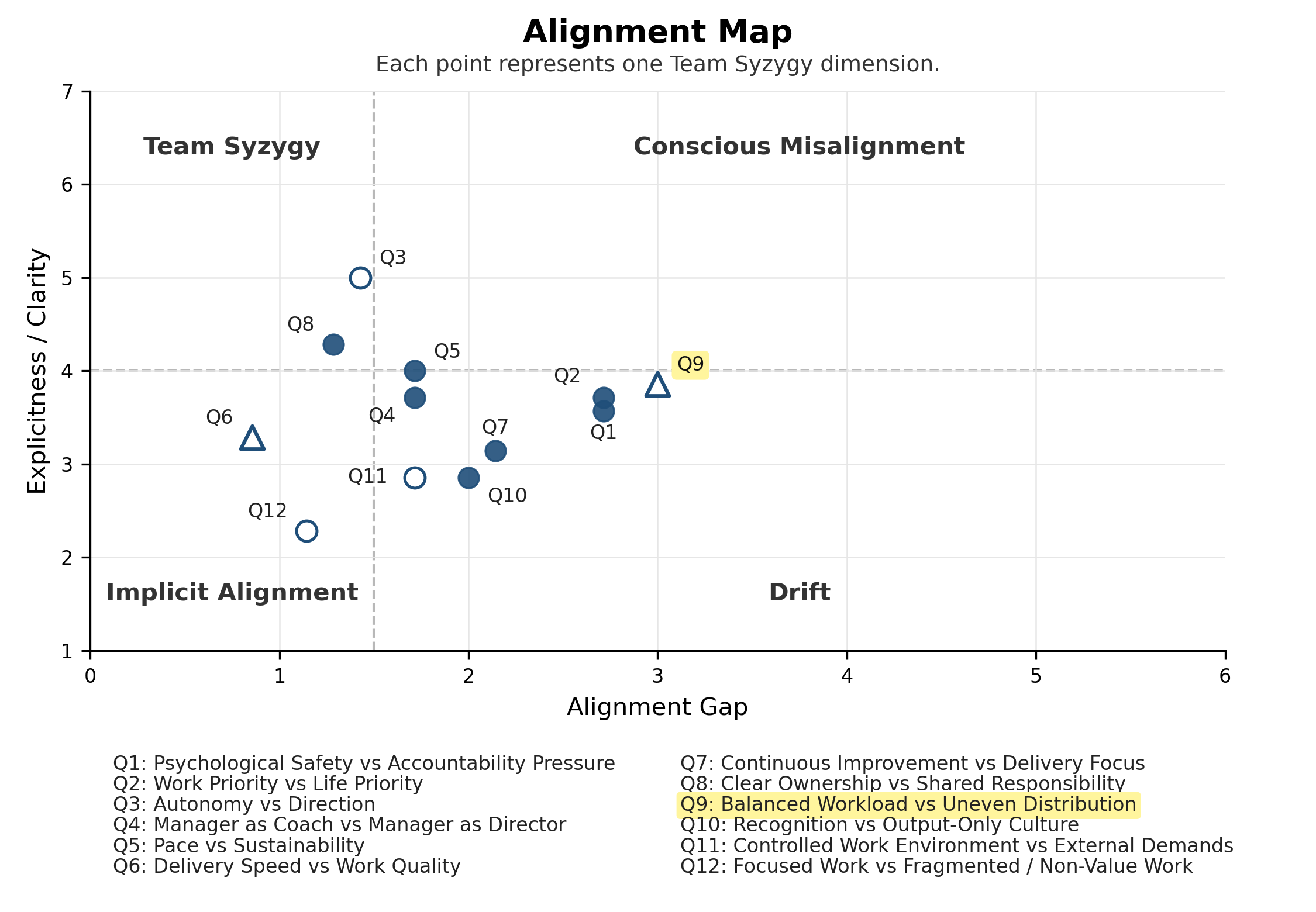
Each point is one Team Syzygy dimension. The horizontal axis shows alignment gap (how far personal preferences sit from perceived team norms). The vertical axis shows explicitness (how clearly that area is discussed and understood).

Team Syzygy Alignment Map

The map shows a broad drift pattern: seven of twelve dimensions sit in Drift, including the primary workload fairness dimension and three supporting theme dimensions.

Quadrants

  • Team Syzygy: Clear, shared, and intentional alignment.
  • Implicit Alignment: We agree, but it is not explicitly defined.
  • Conscious Misalignment: The system is clear, but does not match individual preferences.
  • Drift: People are moving in different directions without openly addressing it.

Overview

Qualitative lookup across all twelve Team Syzygy dimensions.

  • Quadrant: Where the dimension sits on the map: shared alignment, implicit agreement, conscious trade-off, or drift.
  • Gap: Mean absolute difference between personal preference and perceived team norm for the dimension: low below 1.50; moderate from 1.50 to below 2.50; high at 2.50 or above.
  • Explicitness: Team mean score (1–7) for how clearly the area is discussed and understood: low below 3.50; moderate from 3.50 to below 4.50; high at 4.50 or above.
  • Consensus: How closely the team appears to agree, based mainly on spread in personal preferences (and perceived team norm spread for broad): shared means preferences are closely clustered (preference SD below 1.75) and perceived norms are not widely dispersed; broad means preferences cluster but perceived team norms vary more (norm SD at or above 1.75); borderline variation means preference SD from 1.75 to below 2.00, so the average may mask different preferred outcomes; split consensus means preference SD at 2.00 or above, so people appear to want clearly different things on this dimension.
Q-code Dimension Quadrant Gap Explicitness Consensus
Q1 Psychological Safety vs Accountability Pressure Drift high moderate shared
Q2 Work Priority vs Life Priority Drift high moderate broad
Q3 Autonomy vs Direction Team Syzygy low high borderline variation
Q4 Manager as Coach vs Manager as Director Drift moderate moderate broad
Q5 Pace vs Sustainability Conscious Misalignment moderate moderate broad
Q6 Delivery Speed vs Work Quality Implicit Alignment low low split consensus
Q7 Continuous Improvement vs Delivery Focus Drift moderate low broad
Q8 Clear Ownership vs Shared Responsibility Team Syzygy low moderate broad
Q9 Balanced Workload vs Uneven Distribution Drift high moderate split consensus
Q10 Recognition vs Output-Only Culture Drift moderate low broad
Q11 Controlled Work Environment vs External Demands Drift moderate low borderline variation
Q12 Focused Work vs Fragmented / Non-Value Work Implicit Alignment low low borderline variation

How this was produced

Having this conversation well

The sections above are general guidance. Your report's "What to do next" block applies these principles to this team's specific pattern.

What happened

Different views of how the team currently operates and what fair or reasonable looks like.

Feelings

How the pattern affects people — pressure, resentment, pride, worry — without judging whether they should feel that way.

Identity

What is at stake for people (including you) in being seen as competent, fair, and valued.

Example survey dimension

Balanced Workload vs Uneven Distribution

Operating Spectrum

1 — Work should be distributed evenly across team members.

7 — Work should be allocated based on capacity and output, even if some individuals carry more.

Personal Preference

Example team mean: 3.29

1
2
3
4
5
6
7

Perceived Team Norm

Example team mean: 4.57

1
2
3
4
5
6
7

Explicitness / Clarity

Example team mean: 3.86

1
2
3
4
5
6
7
1 — Implicit; Never Discussed. 7 — Explicit; Openly Discussed.

From input to output

Team Syzygy analyses the pattern created when a whole team provides their views across the 12 Team Syzygy dimensions. For each dimension, the output looks at:

Where the team believes the current norm sits

This shows how people experience the team’s way of working today.

Where people’s personal preferences sit

This shows whether the current norm appears to match what people actually want from their working environment.

How large the preference–norm gap is

This shows whether the difference between personal preference and perceived team norm is minor, meaningful, or large enough to deserve attention. The direction of the gap matters. A high gap does not simply mean “there is a problem.” It shows the direction of the mismatch: whether the team is perceived to operate further toward one end of the dimension than people would ideally want.

How explicit the norm feels

This shows whether the team has clearly discussed or agreed how this area should work, or whether people may be relying on assumptions.

How consistent the responses are

This shows whether the team broadly shares the same view, either in personal preference or in perception of the current team norm, or whether the averages may be hiding different experiences inside the team.

These patterns are then translated into manager-facing insight. A dimension may show up as a clear shared norm, an implicit assumption, a known trade-off, or a source of drift where expectations and reality appear to be pulling apart.

The framework also looks beyond each dimension in isolation. For example, a workload fairness gap means something different if recognition, external demands, delivery pressure, or continuous improvement are also showing tension. These combinations help explain what may be making the issue harder to resolve and what kind of conversation would be most useful.

Team Syzygy also looks for steadier areas. Not every dimension needs to become a focus area. Where a team appears more aligned, even if the norm is still implicit, that can provide a stable anchor: something the manager can acknowledge, build from, or use as contrast when discussing the areas that need more attention.

The output follows a simple chain:

Survey responses team-level pattern headline insight recommended conversation

In the sample that follows, the workload fairness pattern illustrated in the example question above does not simply say “workload is uneven.” It shows something more useful: people experience the team norm around workload distribution as more uneven than they would prefer, while a high variance in personal preferences suggests the team may not share one clear definition of what fair workload actually looks like.

That changes the manager’s next step. The first conversation is not necessarily “how do we rebalance all the work?” It is “what do we mean by fair workload, when is unevenness acceptable, and how should extra contribution be recognised?”